How to Translate a Website Into Any Language (Structured Output, No API Key)
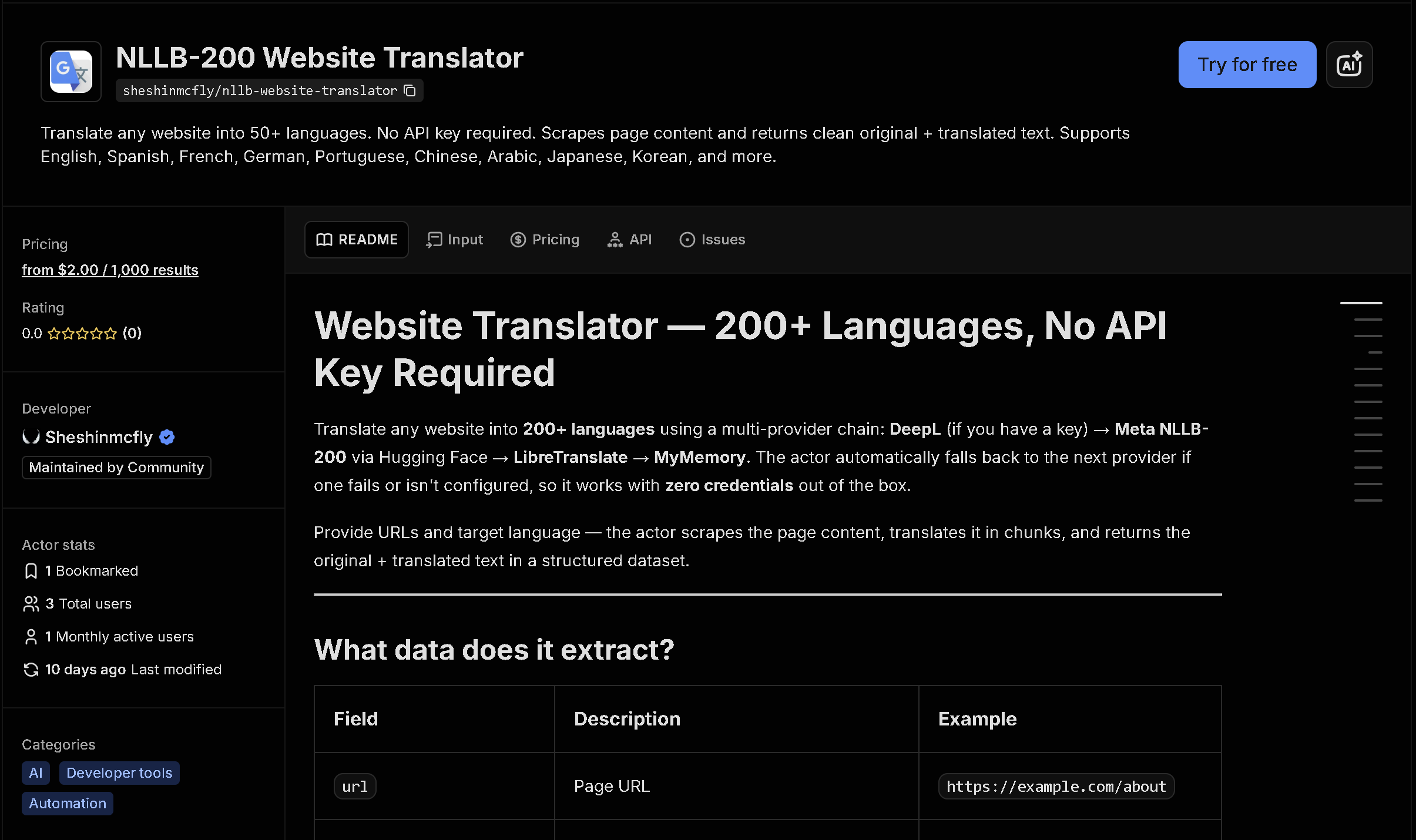
Translating a website page by page in a browser doesn't scale, and most machine translation tools require you to copy and paste text manually. This tool crawls one or more pages, extracts the text section by section, and returns both the original and translated text as structured data — with automatic fallback across four translation providers (DeepL, HuggingFace NLLB-200, LibreTranslate, MyMemory) so a run rarely fails outright.
Sample data
| Section | Original | Translated | Provider |
|---|---|---|---|
| Paragraph 1 | Artificial intelligence (AI) is the capability of computational sys... | La inteligencia artificial (AI) es la capacidad de los sistemas com... | libretranslate |
| Paragraph 2 | High-profile applications of AI include advanced web search engines... | Aplicaciones de alto perfil de AI incluyen motores avanzados de bús... | libretranslate |
| Paragraph 3 | The traditional goals of AI research include learning, reasoning, k... | Los objetivos tradicionales de la investigación de AI incluyen el a... | libretranslate |
| Paragraph 4 | Artificial intelligence was founded as an academic discipline in 19... | La inteligencia artificial fue fundada como disciplina académica en... | libretranslate |
| Paragraph 5 | The general problem of simulating (or creating) intelligence has be... | El problema general de simular (o crear) inteligencia se ha descomp... | libretranslate |
| Paragraph 6 | Reasoning and problem-solving | Razonamiento y solución de problemas | libretranslate |
What each field means
| Field | Description |
|---|---|
url, title, metaDescription, langAttribute | Page identification and its declared language |
sourceLang, detectedSourceLang, targetLang | Requested and auto-detected source language, and the target language |
sections | Array of page sections, each with the original text, translated text, HTML tag, and which provider translated it |
primaryProvider, providers | Which translation provider was used, and the fallback chain available |
How to use it
- Open the tool on Apify (link below).
- Fill in the search form — no code required.
- Run it and wait for it to finish (usually seconds).
- Download your results as JSON, CSV, or Excel.
Frequently asked questions
Do I need to know how to code?
No. You enter the URL(s) you want translated and a target language, then download the results as JSON, CSV, or Excel.
Is this real-time data?
Yes, every run fetches the current page content and translates it at the time you run it.
Do I need an API key?
No. It works out of the box with free providers (LibreTranslate, MyMemory). You can optionally add your own DeepL or HuggingFace key for higher quality.